Mission Report · MapMyIndia [Gtropy]Project case study
Control Tower
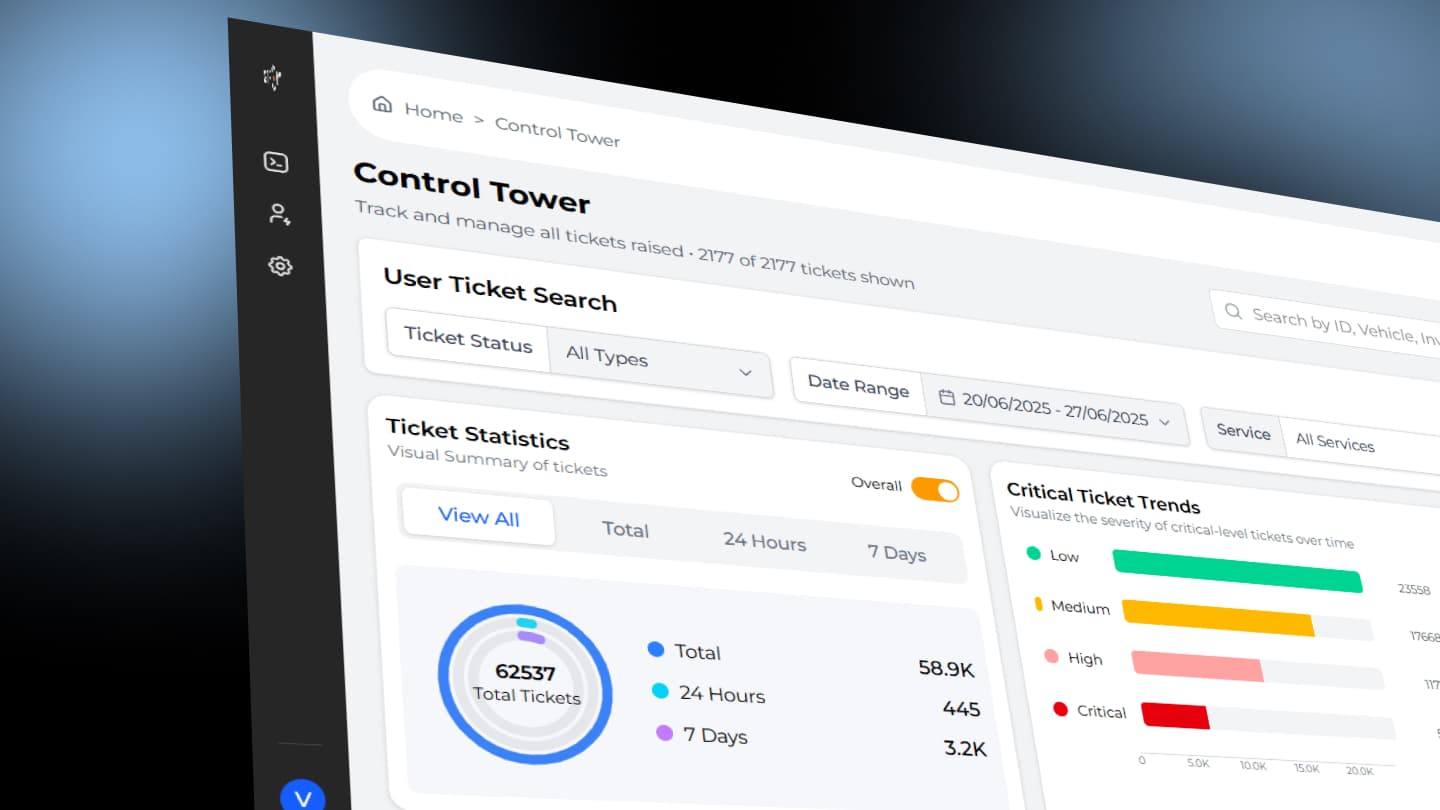
The system knew everything. It just didn't know what mattered first.
- Status
- Shipped
- Owned
- Frontend · dashboard architecture
- Domain
- Alerts & ticketing
- Stack
- React
- TypeScript
- RxJS
- Mappls SDK
ResultsNot yet measured
- Time from alert to ticket
- Tickets resolved per operator
A real-time alert management and ticketing platform with map-based trip analysis.
An alert that fires constantly stops being an alert. It becomes background noise with a red icon.
Operations teams responsible for monitoring alerts, working tickets and investigating trips.
Alerts arrive continuously; humans work in queues. The product's job was to turn the first into the second, and to let an operator see where and when an alert happened, not just that it did.
Turning a continuous stream of vehicle events into a queue a human can actually work through.
If an alert can be opened straight into the trip it came from, with playback, most investigations become a minute of looking rather than a chain of questions.
A modular React and TypeScript frontend on Vite, with heavy routes lazy-loaded and the bundle code-split, so the initial view is fast and the map-heavy analysis loads only when asked for.
The alert and ticket queue first, then map playback of trips, then the analytics on top. Performance work was scheduled as a feature, not deferred as a cleanup.
Alerts grouped and prioritised so the queue reads top-down; a ticket is one click from its trip; playback controls let an operator scrub to the moment the alert fired.
Clean separation between the queue, the map and the ticket detail, so an operator can keep the queue in view while investigating one item.
Performance-optimised architecture; map-based trip analysis.
Built the complete frontend: Vite, React, TypeScript, map SDKs and REST APIs. Lazy loading and code-splitting reduced the initial bundle; rendering paths were optimised for continuous updates.
Faster initial load and perceived responsiveness through the bundling strategy, and an alert workflow operations teams could analyse spatially and temporally rather than as a list.
In a real-time product the frontend architecture is part of the UX. Decisions about what loads when were felt by operators as decisions about how quickly they could respond.